
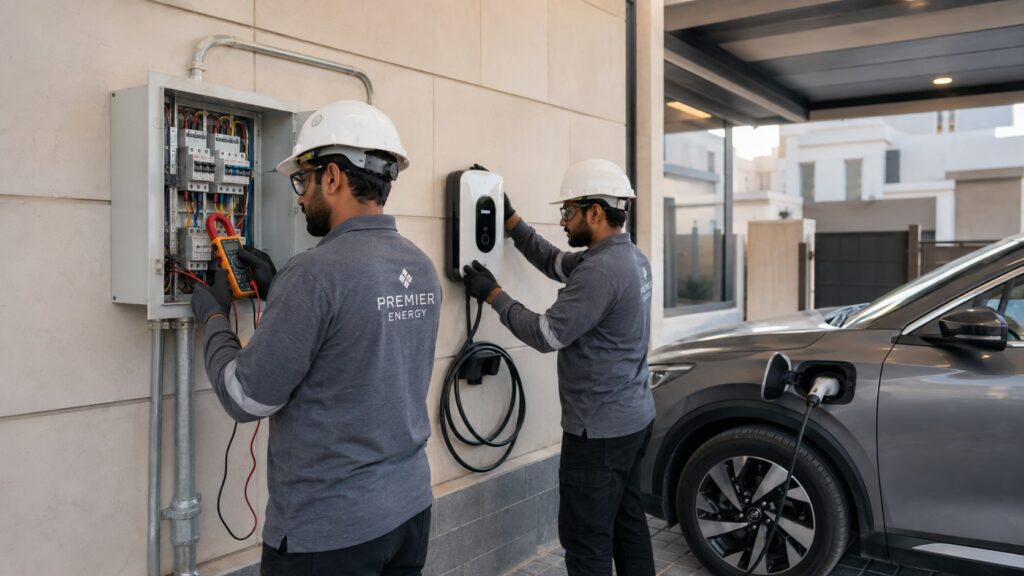
If you are planning a home EV charger installation in Al Waab, one of the first decisions is usually:
Should I install a 7 kW, 11 kW or 22 kW charger?
The answer is not simply “choose the biggest charger.”
The correct charger depends on:
Your electric vehicle
The vehicle’s maximum AC charging capacity
Single-phase or three-phase electrical supply
Available electrical load
Distribution board capacity
Charger specifications
Daily driving distance
How long the vehicle normally remains parked
Cable route between the DB and parking area
Current KAHRAMAA requirements
A 22 kW charger may look more attractive on paper, but if your vehicle can accept only 11 kW AC, installing a 22 kW wallbox will not make that vehicle charge at 22 kW.
For many homeowners, a properly selected 7 kW or 11 kW home charger may already provide enough overnight charging.
Electrician Doha provides EV charger installation in Al Waab, including site assessment, cable-route planning, distribution-board checking, installation and testing.
We also serve nearby areas including Baaya, Villaggio Area and Aspire Zone.
Call / WhatsApp: +974 7144 0420
Quick Comparison: 7 kW vs 11 kW vs 22 kW
| Charger Rating | Typical AC Supply Arrangement | Approx. Energy Delivered per Hour* | Often Suitable For |
|---|---|---|---|
| 7 kW | Commonly single-phase | Around 7 kWh | Overnight home charging, moderate daily driving |
| 11 kW | Normally three-phase | Around 11 kWh | Faster home charging where vehicle and supply support it |
| 22 kW | Normally three-phase | Around 22 kWh | Vehicles that support higher AC charging and properties with sufficient capacity |
*These are simplified nominal figures. Actual charging speed can be lower because of the vehicle’s onboard charger limit, battery conditions, charger settings, electrical supply, temperature and charging losses.
The most important rule is:
Your actual charging speed is limited by the weakest part of the charging system.
For example, if you install a 22 kW wallbox but your vehicle’s onboard AC charger accepts a maximum of 11 kW, your vehicle will normally charge at no more than approximately 11 kW AC.
Before Comparing Charger Sizes, Check Your Vehicle First
The first question should not be:
“How powerful is the charger?”
It should be:
“How much AC charging power can my vehicle accept?”
Different EV models have different onboard AC charging limits.
Depending on the vehicle, its AC charging capability may be approximately:
3.6 kW
7 kW / 7.4 kW
11 kW
22 kW
Another manufacturer-specified rating
Therefore, before purchasing or installing a charger, confirm:
Vehicle make
Vehicle model
Model year
Charging connector
Maximum AC charging rate
Single-phase or three-phase AC charging capability
The vehicle manual or manufacturer’s technical specifications should provide this information.
What Is a 7 kW Home EV Charger?
A charger commonly described as 7 kW or 7.4 kW is a popular option for residential charging.
It is often suitable for drivers who park their EV at home overnight.
For example, if a vehicle stays parked for 8 hours, a 7 kW charger can theoretically deliver a substantial amount of energy during that period, although real-world charging will vary.
A 7 kW Charger May Be Suitable If:
Your vehicle accepts approximately 7 kW AC
Your property has an appropriate electrical supply
You normally charge overnight
Daily driving distance is moderate
You do not need very rapid home charging
Available electrical capacity does not justify a larger charger
For many residential users, 7 kW can provide a practical balance between charging speed and electrical-load requirements.
Advantages of a 7 kW Charger
Potential advantages include:
Lower Electrical Demand
It normally places less demand on the property’s electrical system than an 11 kW or 22 kW charger.
Suitable for Overnight Charging
If the car remains parked for several hours every night, maximum charging speed may not be necessary.
May Require Less Electrical Modification
Depending on the existing installation, a lower-power charger may be easier to accommodate.
However, a site assessment is still required.
Compatible with Many EVs
Many electric vehicles support AC charging around this level.
Limitations of a 7 kW Charger
A 7 kW charger may not be ideal when:
The EV has a large battery
The vehicle regularly returns home with a very low battery
Several long trips are made every day
Faster turnaround between journeys is required
The customer owns an EV capable of substantially faster AC charging and wants to use that capability
In such cases, an 11 kW charger may be worth considering if the property and vehicle support it.
What Is an 11 kW Home EV Charger?
An 11 kW AC wallbox normally requires a suitable three-phase electrical supply.
It can provide noticeably faster charging than a 7 kW unit when the vehicle is capable of accepting 11 kW AC.
An 11 kW Charger May Be Suitable If:
Your vehicle supports 11 kW AC charging
Three-phase power is available
The property has sufficient spare electrical capacity
The distribution board can accommodate the required circuit
You regularly drive longer distances
You want faster home charging than approximately 7 kW
The installation complies with current requirements
For some modern EVs, 11 kW is a very practical home-charging level because the vehicle itself may already be limited to 11 kW AC.
Why 11 kW Can Be a Good Middle Option
An 11 kW charger sits between standard overnight charging and higher-capacity 22 kW charging.
It can be attractive because it offers:
Faster charging than 7 kW
Lower electrical demand than 22 kW
Good compatibility with many three-phase-capable EVs
Practical overnight charging for larger batteries
However, installing an 11 kW charger only makes sense when the vehicle, property supply and electrical system all support it.
What Is a 22 kW Home EV Charger?
A 22 kW AC charger is a higher-capacity residential charging option.
KAHRAMAA’s updated procedures state that residential buildings are limited to AC chargers with a maximum capacity of 22 kW, subject to the applicable approval and installation requirements.
But this does not mean that every villa should install a 22 kW charger.
Nor does it mean every property has enough electrical capacity for one.
When Does a 22 kW Charger Make Sense?
A 22 kW charger may be worth considering when:
The EV genuinely supports 22 kW AC charging
Suitable three-phase supply is available
The property has sufficient electrical capacity
The distribution board can accommodate the required dedicated circuit
Higher home charging speed is genuinely useful
The installation meets current KAHRAMAA requirements
If your vehicle accepts only 11 kW AC, a 22 kW wallbox may still operate with it, depending on charger compatibility, but the car will normally limit charging to its own maximum AC rate.
Therefore:
22 kW wallbox ≠ automatically 22 kW charging.
Is 22 kW Always Better Than 11 kW?
No.
Suppose:
Charger: 22 kW
Vehicle onboard AC charger: 11 kW
The vehicle cannot simply accept 22 kW because the wallbox can provide it.
In that situation, you may pay for:
Higher-capacity charger
Larger electrical infrastructure
Potentially heavier cable requirements
Higher circuit capacity
Additional electrical modifications
without receiving faster charging for that particular vehicle.
This is why vehicle specifications should be confirmed before the charger is purchased.
Simple Charging-Time Example
Consider an EV that needs approximately 40 kWh added to its battery.
Ignoring charging losses and vehicle limitations, the theoretical comparison would be approximately:
| Charger | Approximate Time for 40 kWh |
|---|---|
| 7 kW | About 5.7 hours |
| 11 kW | About 3.6 hours |
| 22 kW | About 1.8 hours |
However, these figures are only theoretical examples.
Actual charging may take longer because of:
Vehicle onboard charging limit
Battery-management system
Battery temperature
State of charge
Charger settings
Electrical supply
Charging losses
Vehicle charging curve
The example is useful for understanding the difference between charger ratings, but it should not be used as a guaranteed charging time.
The Question Most Homeowners Should Ask
Instead of asking:
“What is the fastest charger I can buy?”
A better question is:
“What charging capacity do I actually need for my daily driving?”
For example, a customer who:
Drives moderate distances each day
Returns home in the evening
Parks for 8–10 hours
Charges regularly overnight
may not need the highest possible charging rate.
A properly designed 7 kW installation may be completely adequate.
Another customer who:
Drives long distances
Has limited charging time
Owns an EV supporting 11 kW AC
Has suitable three-phase capacity
may benefit from an 11 kW charger.
A 22 kW charger becomes more relevant when both the vehicle and property can actually make use of it.
Step 1: Confirm the Vehicle Connector
Before EV charger installation in Al Waab, confirm the vehicle’s charging connector.
The charger plug and vehicle inlet must be compatible.
Do not select a wallbox based only on:
Price
Advertised kW rating
Appearance
Mobile application features
Vehicle compatibility comes first.
Send Electrician Doha:
Vehicle make and model
Vehicle model year
Photo of charging port if required
Charger brand/model
Charger datasheet or rating label
This allows us to better understand the proposed installation before the site assessment.
Step 2: Confirm Single-Phase or Three-Phase Supply
The available electrical supply significantly affects charger selection.
A site inspection should confirm whether the property has:
Single-phase supply
Three-phase supply
Appropriate main electrical capacity
Suitable distribution-board arrangement
An 11 kW or 22 kW charger should not be promised simply because three-phase wiring is visible somewhere in the property.
The actual supply and available capacity must be assessed.
Step 3: Assess Available Electrical Load
An EV charger is a significant electrical load that may operate continuously for several hours.
Before installation, the electrician should assess the property electrical system.
This can include:
Main incoming supply
Main breaker
Existing connected loads
Air-conditioning loads
Water heaters
Cooking equipment
Other high-load equipment
Available DB capacity
Phase distribution
Proposed charger rating
A spare breaker space does not automatically mean the property has enough electrical capacity for a 22 kW charger.
Electrical load and circuit capacity must both be considered.
Step 4: Inspect the Distribution Board
The distribution board is an important part of the EV charger assessment.
The technician may need to inspect:
DB condition
Breaker arrangement
Available space
Incoming supply
Earthing arrangement
Existing cable condition
Phase arrangement
Proposed EV circuit connection
Signs of previous overheating or modifications
If the existing DB is not suitable, additional electrical work may be required before installing the charger.
Step 5: Inspect the Parking Location
Choosing the wallbox position is also important.
The technician should check:
Where the vehicle is normally parked
Vehicle charging-port location
Available wall or mounting surface
Distance to the distribution board
Exposure to outdoor conditions
Potential vehicle impact
Pedestrian pathways
Cable reach
Accessibility for future servicing
The charging cable should reach the vehicle comfortably without becoming a regular trip hazard.
Step 6: Measure and Plan the Cable Route
Cable distance can significantly affect the installation.
Possible routes include:
Surface conduit
Electrical trunking
Ceiling/service areas
External walls
Existing service routes
Underground routes where appropriate
The electrician needs to consider:
Total distance
Installation method
Ambient conditions
Protection from physical damage
Cable capacity
Voltage drop
Wall penetrations
Required finishing
A 5-metre installation and a 50-metre installation should not be treated as the same job.
Step 7: Plan a Dedicated EV Charging Circuit
A fixed home wallbox should be planned as a dedicated electrical load.
The installation may require:
Dedicated electrical cable
Suitable circuit breaker
Appropriate isolation
Required electrical protection
Earthing
Cable containment
Outdoor-rated accessories where necessary
Circuit identification and labels
The exact protective arrangement should be selected based on:
Charger specifications
Manufacturer requirements
Electrical system
Current electrical regulations
Current KAHRAMAA requirements
KAHRAMAA’s technical specifications require EV installations to comply with the latest applicable Electricity Wiring Code and relevant electrical standards.
Current KAHRAMAA Requirements Are Important
This is particularly important for homeowners planning an EV charger now.
KAHRAMAA announced updated EV-charger installation procedures on 28 October 2025.
According to that update:
Prior approval is required.
Installation must follow KAHRAMAA’s official procedure.
Applications are to be submitted through a certified electrical contractor.
Residential properties are limited to AC chargers up to 22 kW.
Charging devices are required to connect to KAHRAMAA’s smart platform after installation.
The property owner remains responsible for charger operation and maintenance.
Therefore, the approval pathway and latest requirements should be confirmed before installation begins.
Do not assume that a charger can be purchased and installed immediately simply because the property has enough electrical capacity.
7 kW vs 11 kW vs 22 kW: Which Would We Normally Consider?
Choose Around 7 kW When:
The vehicle supports around this charging rate
Overnight charging is sufficient
Daily mileage is moderate
A suitable electrical arrangement is available
Higher charging capacity is unnecessary
Consider 11 kW When:
The vehicle supports 11 kW AC
Three-phase supply is available
Property capacity is sufficient
Faster home charging would be useful
Consider 22 kW When:
The vehicle supports high-rate AC charging
The property can support the electrical load
Suitable three-phase infrastructure exists
Faster AC charging genuinely provides a benefit
The proposed installation meets current requirements
What If I May Buy Another EV Later?
Future vehicle plans can influence charger selection.
For example, your current car may accept only 7 kW AC, but you may expect to purchase another EV later that supports 11 kW.
In that situation, it can be sensible to discuss future requirements during the initial site survey.
Possible considerations include:
Charger capacity
Cable route
Circuit design
Distribution-board capacity
Load management
Future second EV
Future second charger
However, installing oversized infrastructure “just in case” is not always the most economical solution.
The decision should balance present needs, realistic future plans and site capacity.
What About Two Electric Cars?
If a household expects to charge two EVs, the installation requires additional planning.
Questions include:
Will both vehicles charge simultaneously?
What are their AC charging limits?
Is there enough property capacity?
Would load management be required?
Will there be one charger or two?
How are the parking spaces arranged?
Can both cable routes be installed cleanly?
Two 22 kW chargers should never simply be assumed to require or receive 44 kW simultaneously.
The complete electrical system and charging strategy need to be designed appropriately.
Smart Chargers and Load Management
Some EV chargers provide smart functions such as:
Adjustable charging current
Charging schedules
Mobile application control
Usage monitoring
User access control
Dynamic load management
Solar integration on compatible systems
These features may be useful, but they should not distract from the basic electrical requirements.
The priority order should remain:
Vehicle compatibility
Electrical capacity
Safe circuit design
Current regulatory requirements
Appropriate installation
Then smart features
A charger with an advanced mobile application is not automatically the right charger for the property.
Common Mistakes When Buying a Home EV Charger
Mistake 1: Buying 22 kW Because It Is the Biggest
A 22 kW charger provides little charging-speed benefit if your vehicle accepts only 7 or 11 kW AC.
Mistake 2: Buying the Charger Before Checking the Property
The existing electrical supply may not support the selected charger rating without modification.
Mistake 3: Ignoring the Vehicle’s Onboard Charger
The car—not just the wallbox—determines the maximum AC charging rate.
Mistake 4: Ignoring Cable Distance
A long route between the DB and parking space can significantly change the installation requirements.
Mistake 5: Assuming a Spare DB Space Means Capacity Is Available
Physical breaker space and available electrical load are different things.
Mistake 6: Selecting the Charger Without Checking Current Approval Requirements
KAHRAMAA’s updated procedures require approval before EV charger installation.
What Information Should You Send Us Before a Site Visit?
For an initial assessment, send Electrician Doha:
Vehicle Information
Make
Model
Model year
Charging connector
Maximum AC charging capacity, if known
Charger Information
Brand
Model
Rated capacity
Photo of charger
Specification label
Datasheet if available
Property Information
Location
Villa/townhouse/property type
Photo of distribution board
Photo of parking location
Approximate DB-to-parking distance
Single-phase or three-phase information if known
Photos can help with preliminary planning, but the final technical recommendation should be based on the actual installation conditions and applicable requirements.
EV Charger Installation in Al Waab
Electrician Doha provides EV charger assessment and installation services for villas and residential properties in Al Waab.
Depending on the confirmed scope, our service can include:
Site inspection
Vehicle and charger compatibility review
Parking-position assessment
DB inspection
Electrical load assessment
Cable-route measurement
Dedicated circuit installation
Cable containment
Breaker and protection installation
Wallbox mounting
Cable connection
Labelling
Electrical testing
Charger functional testing
Vehicle charging test
Basic operating demonstration
The exact work depends on the charger model, vehicle, supply and property.
EV Charger Installation Near Baaya, Villaggio and Aspire Zone
Our service coverage also includes nearby areas such as:
Baaya
Villaggio Area
Aspire Zone
Al Waab
Ain Khaled
Abu Hamour
Al Rayyan
Al Sadd
Nearby Doha areas
For residential compounds or managed properties, landlord, owner or facility-management permission may also need to be considered.
What Affects EV Charger Installation Cost?
Installation prices can vary considerably.
Important factors include:
7 kW, 11 kW or 22 kW charger
Single-phase or three-phase installation
DB-to-charger distance
Required cable size
Cable route
Conduit or trunking
Distribution-board modifications
Breaker and protection requirements
Outdoor installation
Underground cable work
Wall drilling
Civil work
Charger mounting location
Approval requirements
Testing and commissioning
Whether the charger is customer-supplied or contractor-supplied
For this reason, a final price should not be confirmed simply from the advertised charger rating.
Frequently Asked Questions
Is a 22 kW EV charger allowed at a home in Qatar?
KAHRAMAA’s October 2025 updated procedure permits residential AC chargers up to a maximum of 22 kW, subject to prior approval and the applicable installation requirements.
Is 22 kW better than 11 kW?
Not necessarily. If your vehicle supports only 11 kW AC charging, a 22 kW wallbox will not make that vehicle charge at 22 kW.
Is 7 kW enough for home charging?
For many drivers who charge overnight, 7 kW can be sufficient. The decision depends on battery size, daily driving, parking duration and vehicle charging capability.
Does an 11 kW charger require three-phase electricity?
11 kW residential AC charging is normally associated with a suitable three-phase supply. The actual property supply and charger requirements should be checked before installation.
Does a 22 kW charger need three-phase supply?
22 kW AC wallboxes normally rely on a suitable three-phase electrical arrangement. The specific charger and property supply must be confirmed.
Can I install a 22 kW wallbox for a car that charges at 7 kW?
It may be technically compatible in some cases, but the vehicle will still limit its AC charging rate. Buying a larger wallbox therefore does not automatically provide faster charging.
Can you tell me which charger to buy?
We can review the vehicle specifications, charger rating and site conditions before recommending an appropriate installation approach. The final choice should also consider manufacturer specifications and current regulatory requirements.
Can you install a charger that I have already purchased?
The charger should first be checked for its connector, rating, specifications and suitability for the vehicle, property and applicable requirements.
Can you give the final price from photos?
Photos can help with an initial assessment. A final quotation may require site measurement, DB inspection, load assessment and confirmation of the proposed installation route.
Which Charger Should You Choose for Your Al Waab Home?
There is no single charger size that is best for every EV owner.
For many properties:
7 kW offers practical overnight home charging.
11 kW can provide a useful speed increase when both the car and property support three-phase charging.
22 kW is appropriate only where the vehicle, electrical capacity, supply and current requirements allow the additional charging capability to be used effectively.
The best approach is therefore:
Vehicle → Property → Electrical Load → Charger → Installation
—not simply buying the largest wallbox first.
Planning an EV Charger Installation in Al Waab?
Before purchasing or installing a wallbox, confirm your vehicle model, charger model, charging capacity, electrical supply, parking position and cable route.
Electrician Doha can inspect the site, assess the proposed installation and carry out the agreed EV charging work in Al Waab, Baaya, Villaggio Area, Aspire Zone and nearby Doha areas.
Call / WhatsApp: +974 7144 0420
When contacting us, send:
Vehicle make/model
Charger photo/model
Charger kW rating
DB photo
Parking-area photo
Location
This helps us understand your requirement before the site assessment.