
Installing a home EV charger can make daily charging more convenient for electric-vehicle owners in Lusail. However, the work should not begin by simply selecting a wall and mounting the charger.
Before arranging EV charger installation in Lusail, you should confirm the vehicle requirements, charger specifications, available electrical capacity, parking position and cable route. Proper planning helps prevent compatibility problems, unnecessary electrical modifications and unexpected costs.
Electrician Doha provides site assessment, installation and testing for home EV chargers in villas and townhouses across Lusail, including Fox Hills and Wadi Lusail.
Call or WhatsApp: +974 7144 0420
Information to Prepare Before the Site Inspection
Before requesting a technical assessment or quotation, prepare the following information:
- Vehicle make, model and year
- Vehicle charging-connector type
- Charger brand, model and rated capacity
- Single-phase or three-phase charger requirement
- Preferred charger location
- Approximate distance between the parking area and distribution board
- Photos of the charger, parking area and electrical distribution board
- Property-owner or compound-management requirements, where applicable
Providing these details allows the electrician to understand the basic requirements before visiting the property. However, the final technical recommendation and price should be confirmed only after checking the actual site conditions.
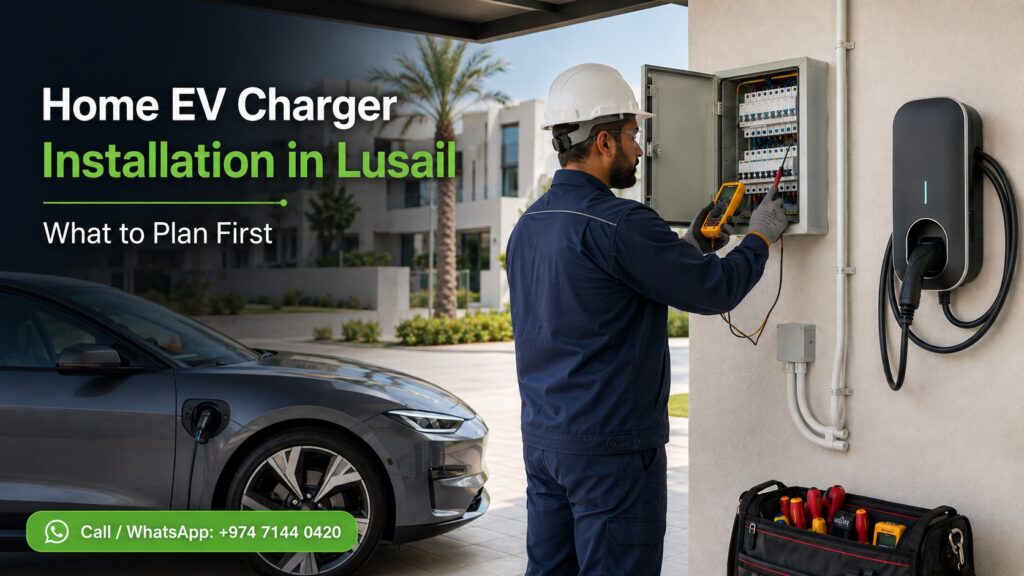
1. Confirm the Vehicle and Charger Compatibility
The first step is to confirm that the charger is suitable for your electric vehicle.
The charger connector must match the vehicle’s charging inlet. You should also check the vehicle manufacturer’s recommended charging specifications and the maximum AC charging capacity supported by the vehicle.
A wallbox with a higher advertised rating will not automatically provide faster charging. The actual charging arrangement must be compatible with:
- The vehicle
- The wallbox charger
- The available electrical supply
- The property’s distribution system
- Current installation requirements
Send the charger datasheet, product label or model number to the electrician before installation. Avoid purchasing an unfamiliar charger without confirming its specifications, warranty support and suitability for use in Qatar.
2. Select the Correct Charger Rating
Residential EV chargers normally use an alternating-current supply. KAHRAMAA has stated that residential buildings may install AC chargers with a maximum capacity of 22 kW, subject to applicable requirements. This maximum does not mean that every villa or townhouse can support a 22 kW charger.
The suitable charger capacity depends on factors such as:
- Vehicle charging specifications
- Existing electrical load
- Main supply capacity
- Single-phase or three-phase availability
- Distribution-board capacity
- Cable length and installation method
A site assessment is therefore necessary before selecting the final charger rating or promising a specific charging speed.
3. Inspect the Parking Position
The charger should be located where it can be used safely and conveniently every day.
During the site survey, the electrician should check:
- The normal parking position of the vehicle
- The location of the vehicle’s charging port
- The wall or mounting surface
- Protection from vehicle impact
- Exposure to direct sunlight, water and outdoor conditions
- Whether the charging cable could create a trip hazard
- Accessibility for future maintenance
- Distance from the charger to the vehicle
The charger should be positioned so that the cable reaches the charging port comfortably without being stretched, driven over or left across a walkway.
KAHRAMAA’s technical guidance requires suitable protection for outdoor electrical components and states that charging cables and receptacles should be arranged to reduce physical damage.
4. Plan the Cable Route Before Installation
The route between the distribution board and the charger can significantly affect the scope and cost of installation.
Possible cable routes may include:
- Surface-mounted trunking
- Electrical conduit
- Ceiling or service areas
- External walls
- Underground routes
- Existing electrical pathways, when technically suitable
The route should be inspected for its length, access, heat exposure, bends, wall penetrations and protection from damage.
In Fox Hills and Wadi Lusail, the arrangement can vary between individual villas, townhouses and managed developments. A route that appears short from the parking area may require additional work if the distribution board is located on another side of the property.
The electrician should agree on the visible cable route and finishing method with the customer before beginning the installation.
5. Assess the Existing Electrical Load
An EV charger can operate for several hours continuously, so the property’s existing electrical system must be assessed carefully.
The assessment should include:
- Main electrical supply
- Main breaker rating
- Current connected loads
- Distribution-board condition
- Available breaker space
- Phase arrangement
- Earthing condition
- Existing cable condition
- Possibility of future load increases
KAHRAMAA’s technical specifications treat EV charging as a continuous electrical load and require the equipment and supplying circuit to be adequately rated.
The electrician should not assume that spare space inside the distribution board means sufficient electrical capacity. Load assessment and physical inspection are both required.
Where the available capacity is limited, the customer may need a lower charger setting, controlled charging arrangement, load-management solution or further electrical modification. Any recommendation should be based on the charger model and actual site conditions.
6. Plan a Dedicated Circuit and Suitable Protection
A fixed home EV charger should normally be supplied through a properly designed circuit rather than connected casually to an existing general-purpose circuit.
Depending on the charger specifications and current requirements, the installation may include:
- Dedicated power cable
- Suitable circuit breaker
- Local isolation
- Required fault and personnel protection
- Effective earthing
- Weather-resistant accessories
- Cable containment
- Circuit and equipment labelling
Cable size and protective-device ratings cannot be selected from charger capacity alone. The electrician must also consider the cable length, installation route, ambient conditions, voltage drop and manufacturer’s instructions.
KAHRAMAA’s published guidance requires compliance with the latest applicable Electricity Wiring Code and relevant electrical standards. It also includes requirements for circuit labelling, overcurrent protection and protection against electric shock.
7. Confirm Permissions and Current Requirements
Before installation, confirm whether permission is required from:
- The property owner
- Landlord
- Compound or community management
- Facilities-management company
- Relevant authority under the current process
This is particularly important where cables will pass through common areas, external façades, shared parking spaces or managed electrical rooms.
KAHRAMAA requirements and approval procedures may be updated. The applicable rules should therefore be checked again for the specific property and charger before technical work begins.
8. Installation, Labelling and Testing
After confirming the charger model, circuit design and cable route, the installation can be scheduled.
A properly planned installation may include:
- Isolating the working area safely
- Installing the dedicated cable and containment
- Installing the required breaker and protective equipment
- Mounting the wallbox securely
- Connecting the charger according to its instructions
- Labelling the new circuit and isolation points
- Checking polarity, voltage and earthing
- Testing charger operation and communication
- Connecting the vehicle for a functional test
- Explaining basic operation to the customer
The customer should also receive any charger manuals, access cards, application details, warranty documents and test information supplied with the unit.
What Can Affect the Installation Cost?
A final quotation should be prepared after inspecting the site because the cost can vary according to:
- Charger capacity
- Single-phase or three-phase arrangement
- Distance from the distribution board
- Cable size and quantity
- Type of conduit or trunking
- Distribution-board modifications
- Additional protective equipment
- Wall drilling or civil work
- Outdoor or underground cable routing
- Working-height or access requirements
- Property-management permissions
- Testing and commissioning requirements
- Whether the charger is supplied by the customer or contractor
A price given without confirming the charger model, vehicle model and site conditions may not cover the full installation requirements.
Common Planning Mistakes to Avoid:
Buying the charger before checking compatibility
The selected charger may not match the vehicle connector, supply type or available electrical capacity.
Choosing the wall location without checking the cable route
A convenient wall may be difficult or expensive to connect safely to the distribution board.
Assuming every property can support the maximum charger capacity
The permitted residential maximum does not guarantee that the existing electrical system has enough available load.
Using an existing socket or circuit without assessment
EV charging is a substantial and long-duration load. The supplying circuit must be inspected and designed for the intended use.
Requesting a fixed price from limited photos
Photos are helpful for preliminary assessment, but concealed routes, DB condition and actual measurements may only become clear during a site visit.
EV Charger Installation in Fox Hills and Wadi Lusail
Electrician Doha provides EV charger assessment and installation support for villas and townhouses across Lusail, including:
- Fox Hills
- Wadi Lusail
- Residential compounds
- Private villas
- Townhouses
- Managed residential properties
Our service can include parking-location inspection, cable-route planning, distribution-board checking, charger installation, circuit labelling, testing and customer demonstration.
The charger model, vehicle model, supply type and site conditions must be confirmed before we provide final technical recommendations or pricing.
Frequently Asked Questions
Can I install a 22 kW EV charger in my Lusail villa?
KAHRAMAA permits residential AC chargers up to a maximum of 22 kW, but the suitable capacity for your property depends on its available electrical supply, existing loads, phase arrangement, distribution board and vehicle specifications.
What should I send before requesting a quotation?
Send the vehicle make and model, charger model and rating, photos of the charger, parking area and distribution board, and the approximate distance between the DB and parking position.
Can you install a charger that I have already purchased?
The charger can first be assessed by checking its model, connector, rating, technical documents and compatibility with the vehicle and site. Installation should only proceed after confirming that the unit and proposed electrical arrangement are suitable.
Will the installation require a separate cable from the DB?
A dedicated circuit is generally planned for a fixed wallbox charger. The final cable route, size and protective arrangement must be selected after inspecting the charger and electrical system.
Can you provide the exact cost before visiting?
A preliminary estimate may be possible from clear information and photos. However, a final quotation should be based on the charger specifications, cable-route measurement, electrical-load assessment and distribution-board condition.
Book an EV Charger Site Assessment in Lusail
Planning the installation correctly is the most important step toward safe and reliable home charging.
Electrician Doha can inspect your parking position, proposed cable route and distribution board before recommending the installation arrangement. We can then install, label, test and demonstrate the charger according to the confirmed scope and applicable requirements.
Call / WhatsApp: +974 7144 0420
Service Area: Lusail, Fox Hills, Wadi Lusail and nearby Doha areas.